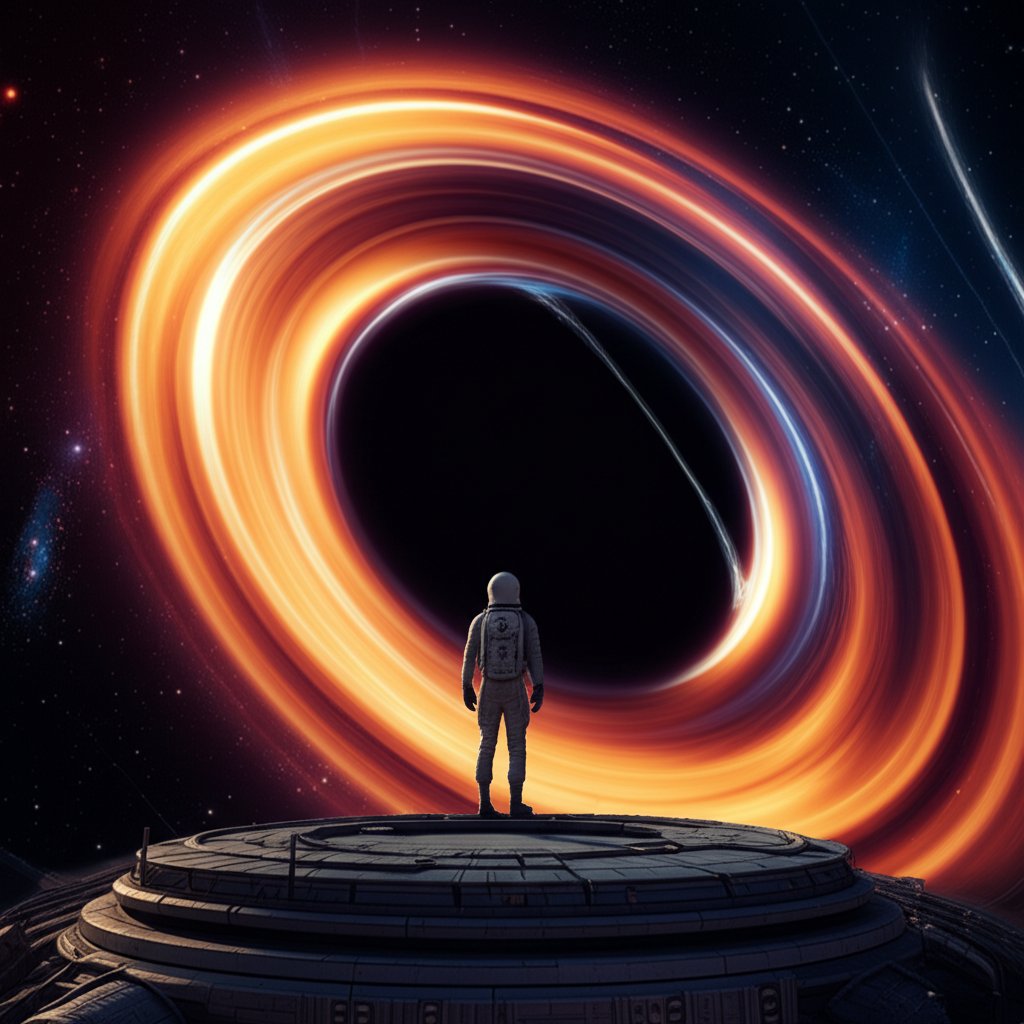
Unraveling the Mystery: What is the True Number of Universe?
Read about Unraveling the Mystery: What is the True Number of Universe? on physics

Decoding the Enigma: How Many Universes Truly Exist?
Delve into cutting-edge scientific hypotheses and groundbreaking revelations concerning the makeup of our cosmos, its ever-quickening growth, and the captivating notion of multiple universes. This journey requires confronting the enigmatic properties of both dark energy and dark matter.
In Brief: Counting the Cosmos
- The cosmos we observe appears as a solitary, immense, and rapidly expanding entity.
- Dark energy and dark matter constitute roughly 95% of our universe, yet remain fundamentally mysterious.
- Recent research suggests dark energy's influence may not be constant, challenging current models.
- The 'multiverse' hypothesis proposes our cosmic domain could be one of many.
Core Insight: While the observable universe is unique, its underlying mechanisms and potential for multiplicity are complex and subjects of active research.
Our Cosmos: A Solitary, Ever-Growing Domain
Gazing skyward, we perceive a tiny fraction of what scientists call the observable universe. This vast expanse, filled with billions of galaxies and stars, stretches across an estimated 93 billion light-years. But is it the only universe? Our current observations point to just one: our own.
Our understanding relies heavily on the Lambda-Cold Dark Matter (ΛCDM) model. This model describes an expanding universe containing ordinary matter, dark matter, and dark energy, fitting nearly all cosmological data gathered. It suggests a universe that began with a Big Bang, evolved over 13.8 billion years, and continues to expand.
The observable realm's edge is defined by how far light has traveled to us. What lies beyond remains a profound mystery, leading to theories questioning our cosmic home's singularity.
Core Insight: Our observable universe is a finite yet unimaginably large region. While we are part of one, its true extent and uniqueness remain open questions.
The Unseen Constructors: Dark Matter and Dark Energy
To grasp the true nature and potential number of universes, we must confront their dominant, yet invisible, components: dark matter and dark energy. These mysterious forces comprise roughly 95% of the universe's total mass-energy, dictating its structure and expansion. They do not interact with light, making direct detection incredibly difficult.
Here’s a breakdown of their cosmic roles:
| Component | Estimated Proportion | Role in the Universe |
|---|---|---|
| Conventional Matter | ~5% | The visible stuff: stars, planets, galaxies, gas, dust. The matter we can observe and interact with. |
| Dark Matter | ~27% | Provides extra gravitational pull to hold galaxies together and explains observed galaxy rotation. It interacts gravitationally but not electromagnetically. |
| Dark Energy | ~68% | The force responsible for the accelerating expansion of the universe. It acts as a repulsive gravitational force, pushing galaxies further apart. |
Remark: Dark energy's dominance means it has accelerated the universe’s expansion to the point where gravity’s attractive force is overridden.
Without these hidden architects, our universe—with its vast galaxy clusters and accelerating expansion—simply wouldn't exist or would look drastically different. Understanding their fundamental nature is at the forefront of modern cosmology and could reshape our view of the number of universes.
Core Insight: Dark matter and dark energy are the universe's dominant, invisible components, orchestrating its structure and accelerating expansion, yet their true nature remains largely unknown.
The Cosmos in Flux: Is Dark Energy a Fixed Entity?
For decades, the standard cosmological model assumed dark energy—the force behind the universe's accelerating expansion—was a constant, akin to Einstein's cosmological constant (Λ). This idea fit observations well. However, groundbreaking findings from projects like the Dark Energy Spectroscopic Instrument (DESI) now suggest dark energy might not be constant, potentially evolving over cosmic time. This revelation could profoundly impact our understanding of the number of universes.
DESI, mapping 15 million galaxies in 3D, has provided the largest map of our universe. By studying features like baryon acoustic oscillations (BAO) and combining them with early universe observations, researchers hint that dark energy's influence changes. This implies the cosmological constant (Λ) might not fully explain dark energy.
Crucial parameters for understanding cosmic expansion include:
- Hubble Constant (H₀): Measures the current rate of universal expansion, a cornerstone of the Hubble-Lemaître Law.
- Deceleration Parameter (q₀): Indicates how the expansion rate is changing. Positive q₀ means deceleration; negative q₀ (which we observe) indicates acceleration.
Early research by Allan Sandage sought these "two numbers." Later, 1997 breakthroughs by Saul Perlmutter's Supernova Cosmology Project and the High-Z SN Search Team (led by Adam Riess and Brian Schmidt) showed clear acceleration, attributed to Einstein's cosmological constant. This discovery was recognized by the 2011 Nobel Prize in Physics.
Latest DESI measurements, combined with other observations, suggest a more dynamic picture: dark energy evolved over cosmic time. One compelling hypothesis is the Cosmologically Coupled Black Hole (CCBH) model. This model proposes that as stars collapse into black holes, their mass converts into dark energy, leading to an evolving strength linked to star formation. The CCBH model also offers a solution to neutrino mass, integrating their presence into the universe's matter budget.
Insight: If dark energy isn't constant, the universe's future could be drastically different, potentially even leading to a 'Big Crunch' if accelerated expansion reverses.
Core Insight: Recent DESI observations challenge the idea of constant dark energy, suggesting its evolution over cosmic time. Models like CCBH offer dynamic explanations for the universe's accelerating expansion and even address puzzles like neutrino mass.
Revealing the Multiverse: Conceptions Beyond Our Own Cosmos
The idea that our universe might not be the only one—the 'multiverse' hypothesis—is one of cosmology's most tantalizing and speculative concepts, deeply intertwined with theoretical physics. If there truly is a larger number of universes, it means our cosmos is just one bubble in a grand cosmic foam.
Different theories propose how such a multiverse might arise:
- String Theory's Landscape: String theory suggests an enormous number of possible universes (up to 10^500), each with different physical laws and constants. Our universe would simply be one stable configuration, potentially linked to ideas like supersymmetry.
Core Insight: The multiverse hypothesis posits our universe is one among many. Theories like string theory and supersymmetry provide frameworks for multiple realities, though remaining highly speculative.
The Perpetual Search: Instruments and Breakthroughs
The quest to understand the number of universes, or even our own cosmos's fundamental nature, is an ongoing, collaborative effort involving scientists and cutting-edge technology worldwide. These ambitious projects probe cosmic expansion, dark matter, and dark energy, potentially offering glimpses into physics beyond our current understanding.
Key instruments and research directions include:
- Dark Energy Spectroscopic Instrument (DESI): As mentioned, DESI is creating the largest 3D map of the universe, providing unprecedented data on galaxy distribution to study dark energy's evolution.
- Euclid Mission: The European Space Agency's Euclid telescope aims to understand the dark-matter dominated universe's geometry and dark energy's nature by mapping galaxies and dark matter over 10 billion years.
- J-PAS (Javalambre Physics of the Accelerating Universe Astrophysical Survey): This survey will provide precise measurements of galaxy distances and properties to shed light on cosmic expansion and dark energy.
- Large Hadron Collider (LHC) Upgrades: Experiments at CERN's LHC, with high-luminosity upgrades, search for new particles predicted by theories like supersymmetry, which could provide candidates for dark matter particles.
- Underground Dark Matter Detectors: Facilities like the Homestake Gold Mine experiment are deep underground, shielded from cosmic rays, searching for Weakly Interacting Massive Particles (WIMPs), a leading dark matter candidate.
Fundamental Tenet: Scientific progress, especially in cosmology, relies on multiple, independent lines of evidence. Extraordinary claims, like evolving dark energy or the multiverse, require extraordinary evidence.
Through these dedicated efforts, the scientific community hopes to either confirm existing models or discover new physics that fundamentally changes our cosmic perspective. Data from these projects are meticulously analyzed, sometimes using advanced platforms that process online insights to refine theories, making the path forward an exciting one for scientific exploration.
Core Insight: Ongoing projects like DESI, Euclid, J-PAS, and LHC upgrades are crucial for gathering observational evidence to unravel dark energy and dark matter mysteries, and potentially confirm or refute a greater number of universes.
The Horizon Ahead: Unveiling Cosmic Realities
The question of the 'number of universes' is far from settled. While our observable universe appears singular, deeper probes into its constituents and expansion dynamics raise more questions. The evolving nature of dark energy, the elusive dark matter, and the theoretical elegance of multiverse concepts all point to a cosmos far more complex and intriguing than we currently grasp.
We stand at a truly fascinating juncture in cosmology. New data from advanced instruments constantly refine our models, pushing the boundaries of what was thought possible. Whether it's the High-Luminosity upgrade to CERN's LHC, potentially revealing new physics, or new telescopic surveys providing clearer maps of cosmic expansion, the coming decades promise revolutionary insights.
Insightful Reflection: As physicist Carl Sagan wisely stated, "Extraordinary claims require extraordinary evidence." The scientific community is committed to pursuing these claims with rigorous data and open-minded inquiry.
The search for answers is a testament to human curiosity—a relentless drive to understand our place in the cosmos. While the definitive number of universes may remain an enigma, the journey of discovery itself is arguably the most rewarding aspect. Stay curious, for the universe continues to hold secrets waiting to be unveiled.
Core Insight: The search for the true number of universes is an exciting and ongoing journey, with new discoveries and theories continuously pushing the boundaries of our understanding of the cosmos.
FAQ
What constitutes the observable universe?
The observable universe refers to the segment of the cosmos from which light has had sufficient time to reach Earth since the Big Bang. It is a spherical volume, centered on our planet, estimated to be about 93 billion light-years in diameter.
What is dark energy, and why does it hold such significance?
Dark energy is an enigmatic form of energy, making up roughly 68% of the universe's total energy density. Its crucial role lies in driving the cosmos's accelerating expansion, causing galaxies to recede from one another at increasingly rapid velocities.
What precisely is dark matter?
Dark matter represents a conjectured form of matter, accounting for about 27% of the universe's total mass. It neither emits, absorbs, nor reflects light, rendering it undetectable by conventional telescopes.
Is it plausible that dark energy's characteristics might shift over cosmic timescales?
Recent scientific investigations, notably from the DESI survey, suggest that dark energy might not be an invariant force, but could undergo evolution across cosmic epochs. This challenges the long-standing premise of a fixed cosmological constant and unveils fresh avenues for comprehending the universe's ultimate destiny.
What is the foundational idea behind the multiverse theory?
The multiverse theory posits that our universe is merely one among a multitude of universes, all coexisting within a larger 'multiverse.' Various theoretical constructs suggest mechanisms through which such numerous universes could come into being, potentially each governed by unique physical laws.
How are researchers currently seeking answers about the cosmos?
Scientists employ powerful instruments like DESI and Euclid to chart the universe, analyze galactic distribution, and quantify cosmic expansion rates. Particle accelerators and subterranean laboratories also conduct experiments to search for dark matter particles and new physics.